SEPARATE COMPANION · FORTHCOMING
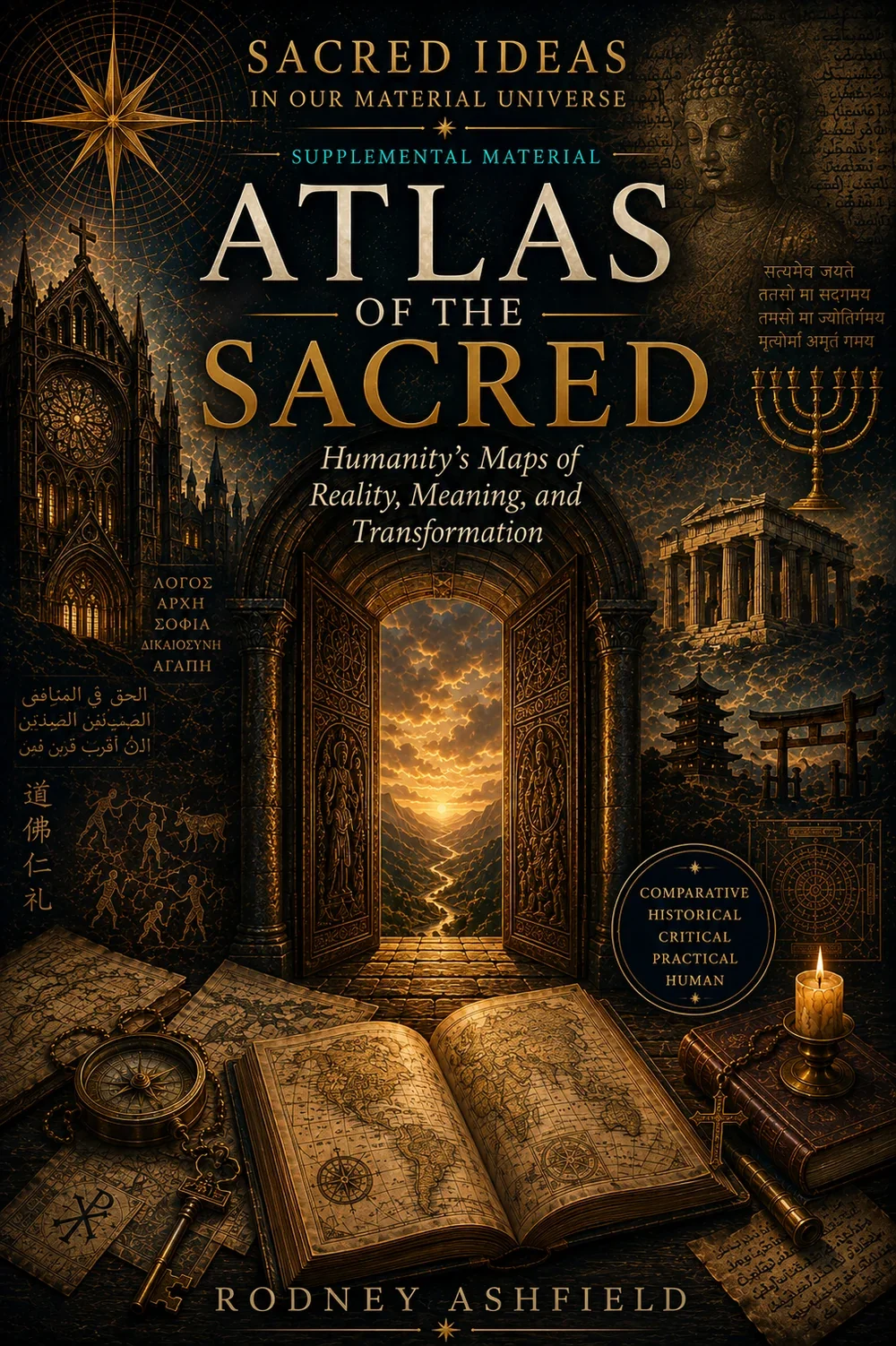
Atlas of the Sacred
Humanity’s Maps of Reality, Meaning, and Transformation. Every human being arrives in a world already mapped. Before we are old enough to question them, we inherit stories about what is real, what matters, who we are, how we should live and where—if anywhere—we belong in the larger order of things.
Forthcoming. Retail availability will be added only after the Amazon listing is live and verified.
THE CARTOGRAPHER IS ALSO ON THE MAP
No map should be confused with the territory itself.
Atlas of the Sacred explores the ways human beings have mapped reality, meaning, morality, suffering, transcendence and transformation—from ancient myth and sacred tradition to philosophy, science, secularism and the modern search for identity and purpose.
It asks not only what traditions say, but what kind of world each one creates for the person living within it.
COMPARISON WITHOUT COLLAPSE
The maps are not all secretly the same.
Their differences are real, sometimes profound and sometimes consequential.
A comparative atlas becomes useless if every road is made to arrive at the same destination. The aim is therefore neither to rank all traditions along a single ladder nor to dissolve them into one comforting common essence.
The task is to understand what each map reveals, what it conceals, what forms of life it encourages and what happens when its boundaries meet another map.
No map is the territory.
Religious history repeatedly shows what happens when a map claims the authority of the territory itself. Texts become final. Interpretations become boundaries. Boundaries become institutions. Institutions become powers capable of deciding who belongs, who speaks and what may be questioned.
Modern secular systems are not immune to the same temptation. Nations, markets, therapies, ideologies and scientific worldviews can also become maps that forget their own partiality.
We are not finished cartographers.
Humanity inherits maps, revises maps and creates new ones. The question is not whether we will live by maps. We cannot avoid them. The question is whether we will know what we are doing when we draw them.