INCANDESCENCE
The fire was never the container.
What our ancestors interpreted as light descending from heaven may also be understood as fire awakening within nature—the material universe, through conscious life, becoming capable of seeing, judging, caring, creating and transforming itself.
THE CORE PROPOSAL
Religion carried something real.
Religions were never merely primitive explanations of weather, disease, death or the origin of the world.
They also became architectures for attention. They told communities when to stop, gather, grieve, celebrate, confess, forgive, remember, serve and look beyond the immediacy of appetite. They trained habits of reverence and restraint. They created language for gratitude, obligation, transcendence and death.
They also accumulated power. Interpretation hardened into authority. Institutions came to treat inherited language, scripture and ritual as though the container itself possessed the fire.
Historical criticism exposed the human histories of sacred texts. Science made supernatural explanations less necessary. Contact among religions made exclusive certainty harder to sustain. Moral change forced inherited authorities to answer questions they had once controlled.
For many people, the old certainty fractured. But the capacities religion carried did not disappear.
We still experience wonder. We still grieve. We still recognize obligations that inconvenience us. We still need belonging, ritual, restraint, service, beauty and forms of self-transcendence. We still encounter moments when ordinary life seems to exceed the language available to describe it.
Incandescence begins there.
THE ARGUMENT IN NINE MOVEMENTS
A cumulative path rather than a replacement creed.
Ritual, belonging, reverence, grief, moral formation, disciplined attention and self-transcendence were not illusions simply because the explanations surrounding them changed.
Interpretations became doctrines; doctrines became boundaries; boundaries became institutions; institutions often learned to speak as though they owned what they had inherited.
Science, historical criticism, religious pluralism and moral development changed what many people could honestly affirm.
Love, wonder, grief, beauty, conscience, gratitude, courage, attention and the hunger for belonging remained part of human life.
Within conscious beings, nature is not merely happening. It is experienced.
A life does not need to be infinite to matter. Finitude changes the conditions of meaning; it does not abolish meaning.
Attention can be trained. Gratitude can be practised. Grief can be given form. Service and celebration can be protected.
The answer to failed institutions cannot simply be no institutions. We need forms that cultivate the fire without claiming ownership of it.
Care, intelligence, creativity and moral responsibility are among the most consequential things nature has produced here. What we do with them becomes our responsibility.
CONSCIOUSNESS AND THE LIVING UNIVERSE
Nature became inward.
This phrase needs care. It does not require the claim that the universe is literally one enormous mind. It does not require consciousness to exist independently of biology. It does not turn mystery into evidence for whatever metaphysics we prefer.
A conscious organism is a place within nature where there is something it is like to be that organism. Events do not merely occur; some of them are felt. The world is not merely represented; for conscious beings it is present.
Artificial intelligence may sharpen the distinction. A machine may increasingly reason, plan, speak, create, remember and appear empathic without thereby establishing that anything is present to itself. If artificial systems eventually do possess genuine experience, the conclusion changes—but the significance of inwardness does not.
Either way, consciousness remains philosophically extraordinary.
PANENTHEISM WITHOUT SUPERNATURAL EXTERIORITY
More than reduction. Less than a supernatural elsewhere.
Incandescence is compatible with a naturalistic form of panentheistic language if the term is used carefully.
The point is not that a supernatural being exists outside the universe and occasionally enters it. Nor is it that the material world is secretly unreal.
The stronger claim is one of non-exhaustion: reality may be wholly natural without being exhausted by the thinnest description of matter as inert stuff. Consciousness, value, relation, emergence, inwardness and the structures through which reality becomes meaningful are themselves features of the natural world.
In that sense, the sacred does not need an exterior location. It can be understood as what becomes possible within reality when matter becomes living, life becomes conscious, consciousness becomes relational and moral, and human beings become capable of reverence, responsibility and deliberate transformation.
This is not proof of God. It is an argument about what we may still mean by sacredness once the supernatural is no longer doing all of the work.
PUBLIC KEYNOTES
Incandescence: The Fire We Mistook for Heaven
Short keynote
The concentrated public argument for conferences, universities, humanist gatherings, churches, cultural institutions, podcasts and filmed events.
Full keynote
The complete historical, philosophical and civilizational arc, with greater room for the religious inheritance, collapse of certainty, consciousness and institutional consequences.
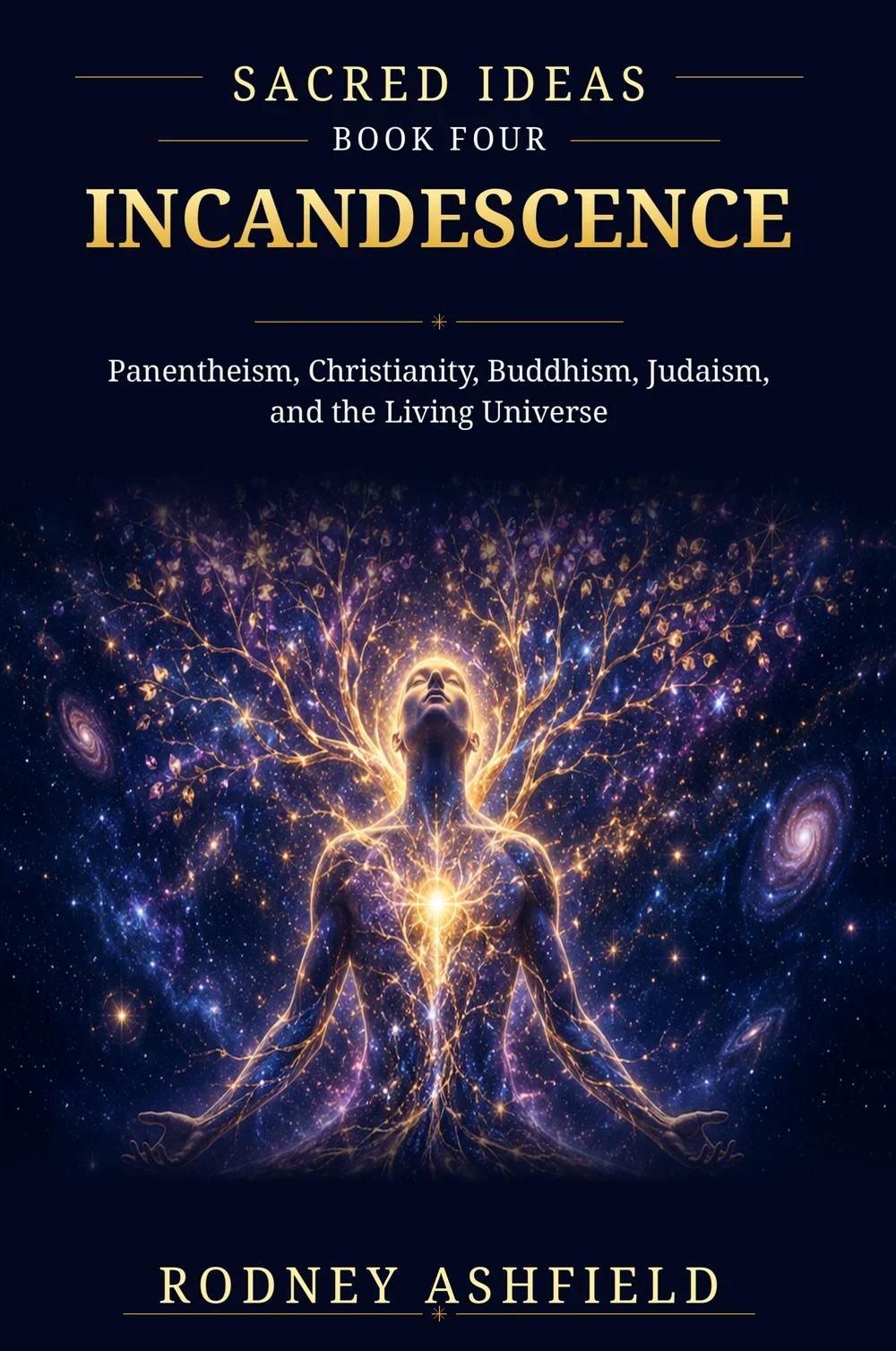
THE BOOK
Incandescence
The fourth book in the Sacred Ideas in Our Material Universe series is the principal book-length gateway into this framework. It places Incandescence in conversation with panentheism, Christianity, Buddhism, Judaism and the idea of a living universe while asking what remains sacred after inherited certainty weakens.
CONTINUE THE ARGUMENT
Continue the argument.
Receive new Sacred Ideas essays, campaign letters and occasional invitations by email.